FAT, SNF, CLR, quantity and rate are recorded at the collection point.
Dairy ERP modules for processing companies
One operating system for milk procurement, production, sales and finance.
Hamari Dairy brings the work of procurement, plant, stores, quality, sales, finance and head office into connected workflows designed for dairy processors, cooperatives and groups.
In short
Dairy production company software connects milk collection and plant intake with stores, manufacturing, quality release, product sales, finance and group reporting. Each team works in its own role-based workflow, while management can trace the quantity, quality, cost and movement behind every outcome.
Connected workflow
Follow the milk, material and money through the business.
Switch between the three operating stages to see how data follows the physical journey across collection, plant operations and distribution.
Stage 1 · source to plant
Every litre starts with a trusted collection record.
Collection at a dairy point, portable pickup and BMC chilling all connect to the same farmer, quality and payment record before the milk reaches plant intake.
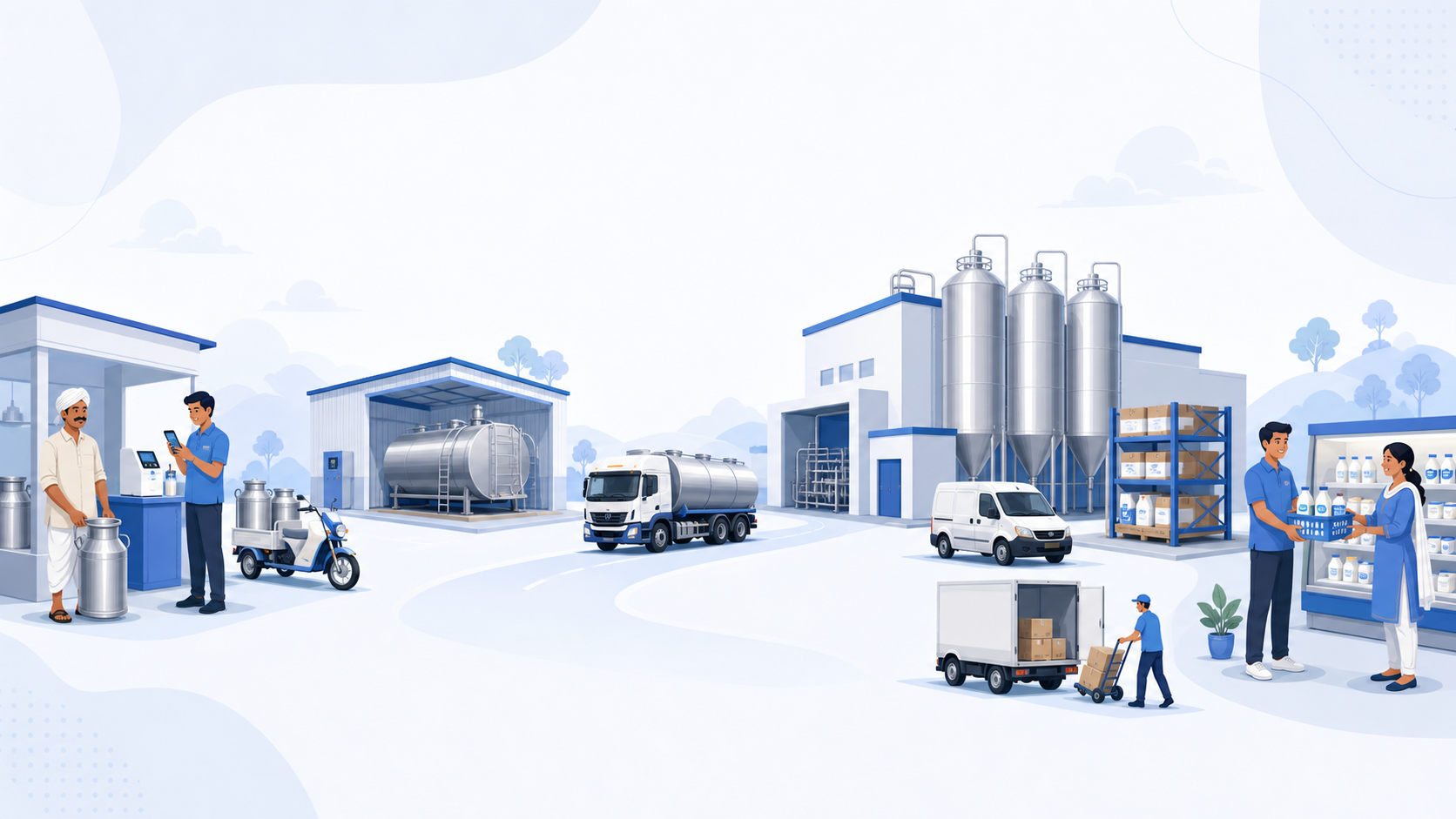 Live workflow view
The farmer can see the receipt, balance and payment status in Hamari Dairy.
Bike, jeep and pickup rounds create the same collection record in the field.
BMC and multi-stop tanker trips carry source records into plant reconciliation.
Farmer to plant route. Each stage keeps the operational record connected to the next team.
Explore milk procurementComplete dairy ERP flow
Collection & procurement
Collection at a dairy point, portable pickup and BMC chilling all connect to the same farmer, quality and payment record before the milk reaches plant intake.
- FAT, SNF, CLR, quantity and rate are recorded at the collection point.
- The farmer can see the receipt, balance and payment status in Hamari Dairy.
- Bike, jeep and pickup rounds create the same collection record in the field.
- BMC and multi-stop tanker trips carry source records into plant reconciliation.
Plant & production
The plant team controls intake, tank and silo movements, materials, manufacturing orders, quality checks and finished-goods inventory from one operating flow.
- Gate weighment, lab results and source-versus-intake variance are reconciled at intake.
- Raw milk moves through tanks, silos, temperature logs, transfers and CIP records.
- Vendor purchases feed materials, packaging and chemicals into controlled stores inventory.
- BOMs, recipes, work orders, batches, QC gates and costing create traceable finished stock.
Sales & delivery
Product and bulk-milk sales connect inventory, customer credit, dispatch, delivery, settlement and financial reporting without a separate handoff.
- Bulk milk and packaged-product orders use customer, credit and approval controls.
- Finished stock can move through sales orders, consignments and van-sales routes.
- Delivery, invoice, credit note and settlement records close the customer journey.
- Sales, vendor payments, stock and production costs flow to daily P&L and reports.
Verified operational coverage
A complete ERP without a generic feature dump.
The modules below are organized around the teams and decisions that run a dairy processing company.
Milk procurement & logistics
Control the milk network from supplier onboarding and rate policy to intake, transport and settlement.
- BMC, dairy and supplier masters, agreements, documents and common charges
- FAT/SNF quality-based rate charts, incentives, advances and farmer disbursements
- Milk collection, testing, bulk and tanker intake, source-to-plant allocations
- Dispatch-versus-intake quality variance, rejection codes and reconciliation exceptions
- Routes, vehicles, drivers, truck sheets, freight, fuel logs and GPS trip records
- Supplier bills, receipts, settlements, payments and procurement reporting
Purchasing, inventory & stores
Run procure-to-pay and keep materials, packaging and stock value visible by item and location.
- Vendor, contact and bank-account records for materials, packaging and services
- Purchase orders, approval queues, goods receipts, vendor bills, debit notes and payments
- Material movements, stock items, locations, rate contracts and on-hand stock balances
- Document-wise item ledger, stock layers, valuation and stock reconciliation
- Material consumption and stock issues linked to production, maintenance and operations
Manufacturing & production costing
Plan, produce and cost finished dairy products from recipe to batch output.
- Product masters, BOMs and recipes for milk, materials, packaging and finished goods
- Process rates, work centres, capacity, routings and scheduled work orders
- Manufacturing orders, batch inputs and outputs, material consumption and wastage capture
- QC-gated batches, production completion and product or batch costing
- Milk allocation to production, storage or sales, with product profitability reporting
Plant floor, tanks & CIP
Give plant operators a live operational record for milk storage, movement, temperature and cleaning.
- Tank and silo masters with current stock, inventory snapshots and movement history
- Tank transfers, join/add entries, wastage and quality-correction adjustments
- Cold-chain temperature readings and tank-level operational history
- CIP programs, chemicals, checklists, cycle logs, verification and step records
- Plant-floor stock and production records that connect with the financial and quality workflows
Quality, traceability & recall readiness
Move from an intake result to controlled lots, traceability and corrective action without separate registers.
- QC sample lifecycle, test results and release or hold decisions
- Finished-goods lots, lot movements and batch-to-product genealogy
- Forward and backward traceability across raw milk, production and distribution records
- Recall cases, affected-lot handling and corrective or preventive action tracking
- Quality variance reporting between truck-sheet, lab and plant results
Sales & distribution
Manage bulk and packaged-product selling with order, credit and distribution controls.
- Bulk milk sales, buyer records and controlled milk allocations
- Product sale orders, sale items, brands and category management
- Consignment transfers and on-hand stock at supplied dairy locations
- Sales requests, credit checks, approval rules and credit overrides
- Sales schemes, credit notes, van sales and route-closure records
Finance, compliance & management reporting
Use one operational and financial record for plant-level control and enterprise reporting.
- Party masters and ledgers, supplier and buyer balances, receipts and payment allocation
- Chart of accounts, journal vouchers, opening balances, cost centres and posting controls
- Bank accounts, cash, transactions, statements and bank reconciliation
- Trial balance, ledger, cash flow, balance sheet, daily P&L and financial reports
- GST returns, TDS, e-invoicing and year-end closing workflows
- Branches, divisions, organization reporting and inter-company postings for groups
People, assets, governance & group control
Give each person the right task and keep assets, approvals and multi-unit operations accountable.
- Employees, attendance, leave, payroll runs and payslips
- Fixed asset register, depreciation, transfers, preventive maintenance and spare issues
- Role-based access, custom permissions, approval workflows and approval inboxes
- Audit events, documents, notifications, supplier supply requests and complaint handling
- Master data, code templates and organization structures across plants and business units
Configured for your operation
One platform. The right modules for each team.
A plant does not need to expose every screen to every person. Hamari Dairy uses enabled modules, roles and implementation sequencing to match the system to each plant, department and group structure.
Explore the workflows
Start with the part of the chain you need to improve.
FAQ
Enterprise dairy ERP questions
Which dairy ERP modules should a processing company start with?
Most plants start by mapping procurement, plant intake, quality variance, supplier billing, production and stock. Hamari Dairy then scopes purchasing, sales, finance, HR, assets and multi-plant reporting around the roles and rollout sequence your operation needs.
Can Hamari Dairy connect procurement to production and finance?
Yes. Milk collection and intake records feed reconciled stock and production workflows, while supplier bills, sales, payments and finance reports use the same operating records. The enterprise discovery confirms the modules, controls and data migration needed for each rollout.
Does every user see every ERP module?
No. Roles and permissions can be configured so plant operators, lab teams, procurement, stores, sales, finance and head office users access the work relevant to them.
Can a dairy group use different modules at different plants?
Yes. The implementation can enable the right workflows per processing unit while connecting group structures, financial reporting and controlled inter-company processes where required.